
Thursday, May 14th, 2026 | By
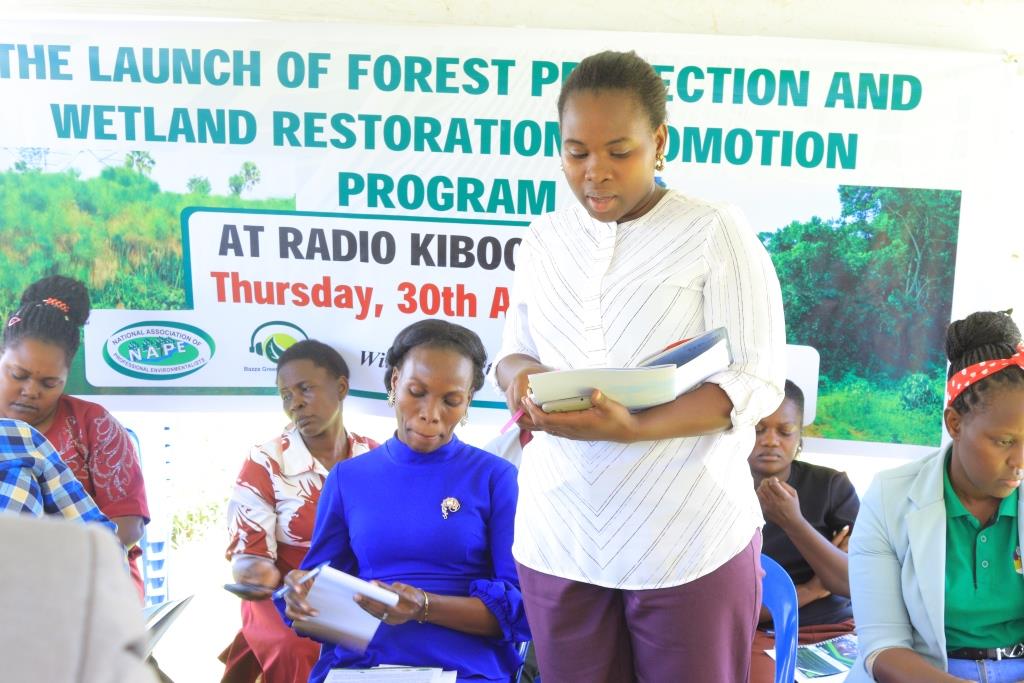
On March 30 2026, at the Community Green Radio premises in Kiboga District, central Uganda, the National Association of Professional Environmentalists, NAPE launched the Forests and Wetlands restoration Promotion program.
The Program is aimed at restoring degraded ecosystems, promoting sustainable land use practices and enhancing community resilience to climate change according to David Kureeba, the Senior Programmes Coordinator Forests, Biodiversity and Climate Change at NAPE.
The Program will entail activities of tree planting, wetland restoration and environmental education in communities, learning institutions and on radio.
The launch was characterized by speeches calling for action especially tree planning accompanied by justification of the same. Lists of the benefits of tree planning were outlined by every speaker who got chance at the microphone.
“We need more trees to regulate our climate, protect our water sources and support agriculture. Without trees, we are exposing ourselves to drought, floods and soil erosion”: Henry Lubanjwa, the Assistant Resident district commissioner, RDC (Presidents representative in the district) for Kiboga explained at the event.
Buganda Kingdom representative at the function, the Sabawaali for Kapeke Parish, Mr. Johbosco Ssenyondo reechoed quite similar calls;
“We have a responsibility to protect our environment for future generations. Let’s work together to restore our forests and wetlands”, Ssenyondo said.
Well, these calls for action look more general to communities, leaders and other stakeholders. However, when looked at critically, the devastating consequences of failure to protect and conserve the environment falls on the home and the woman, traditionally, at least African, is the guardian of a homestead. This implicitly and explicitly implies she bears the most burdens of climate change and its effects.
Climate change acts as a risk multiplier, disproportionately affecting women, who often bear the brunt of environmental disasters due to existing gender inequalities.
Climate change Increases women’s Vulnerability to Disasters. Women and children are up to 14 times more likely to die during climate-induced disasters, partly due to restricted mobility and lack of access to early warning information. Most women are in rural areas and are under strict control and restriction of their husbands and thus chances of getting exposed to certain information are minimal or tending towards none.
Climate change is responsible for long periods of drought and excessively heavy rains the lead to food insecurity. Women face higher rates of food insecurity, with projections suggesting climate change could cause 47.8 million more women to face hunger compared to men. By 2050, 158 million more women and girls could be pushed into poverty, 16 million more than men and boys.
Extreme heat, pollution, and water scarcity increase health risks. Vector-borne diseases like malaria and Zika rise with temperatures, leading to higher rates of miscarriage, premature birth, and maternal complications.
As water and fuel become scarcer, women and girls must walk further to collect them, decreasing time for education and economic opportunities.
Disasters and displacement increase the risks of sexual violence and exploitation in crowded, unsafe, or temporary shelters. Drought-related economic stress is directly linked to higher rates of intimate partner violence.
Displacement and Education. Approximately 80% of people displaced by climate change are women and girls. In these contexts, young girls are often forced into early marriage, with 12 million girls married annually, a trend exacerbated by climate-driven poverty.
The aforementioned factors bring clearly into perspective the need for women to be involved in all efforts aimed at curbing climate change. Women are critical to climate action. Their unique,, localized knowledge regarding farming, seed storage, and resource management makes them key to building resilience in their communities. Investing in female empowerment and ensuring their representation in climate policies is considered essential to successful climate adaptation and mitigating the worst impacts of the crisis.
Forest Restoration & Wetland Promotion Program Is a community-based environmental initiative focused on reversing land degradation while promoting the value and sustainable use of natural ecosystems. It’s also a coordinated set of activities that do bring back trees and ecological health to degraded, deforested, or bare land. Wetland Promotion – Protecting existing wetlands and restoring damaged ones, while educating people on why wetlands matter for water, climate, and livelihoods. Forests and wetlands work together as a water system. Forests on hillsides slow rainwater, reduce erosion, and recharge groundwater. Wetlands in valleys filter that water, store it, and release it slowly into the aquifers.
Uganda loses approximately 122,000 hectares of forest land annually, with forest cover decreasing from 24% in the 1990s to roughly 13% recently. This is largely caused by Unregulated Logging and Timber Demand, Urbanization and Infrastructure Expansion, Weak Governance & Land Tenure Issues, Biomass Energy Demand, High Population Growth & Poverty, Agricultural Expansion among others.
Wetlands are disappearing three times faster than forests, with approximately 35% of global wetlands lost between 1970 and 2015. Driven by agricultural expansion, urbanization, and climate change, this rapid degradation threatens biodiversity and reduces critical carbon sinks, with the highest rates of loss occurring in developing nations. Nearly a quarter of remaining wetlands are in poor ecological condition. In Uganda, wetland coverage declined from roughly 15.5% in 1994 to approximately 8.9%–9.3% in 2024–2025. The major trends and drivers include; Rapid Urban and Industrial growth, encroachment, Institutional and Legal Weaknesses. Wetlands and forests don’t work in isolation. Their environmental services work in complementarity.
Copyright ©2026 Community Green Radio . All Rights Reserved. Designed : Lwegatech