
Communities affected by the East Africa Crude Pipeline, EACOP in Kiboga District in central Uganda are calling for more engagements with media practitioners about their plight.
Residents of Kibiga, Lwanda and Kimbejja villages in Kibiga Sub County say their engagements with Journalists of Community Green Radio have started attracting attention of stakeholders.
They Say their voices are heard far and while when they speak to the press.
Ssewanyana Charles of Lwanda Village says whenever their voices are heard over radio, leader usually call them for attention.
“Last month when our voices appeared on radio, our area councilor called us for a meeting”, Ssewanyana reported.
Ms. Sarah Nagirinya of Kimbejja says the voices of women can now go far and wide. Issues of rural women are starting to attraction and attention of leaders.
“There is growing recognition of the position of women and their contribution. As women, we are coming from far is matters relating to our position in society. There is even hope that we shall benefit from compensation of property affected by the EACOP”, Ms. Nagirinya narrated.
Community Green Radio, with support of partners, has been conducting community outreaches to capture salient issues affecting them, especially those affected by the EACOP.
There outreaches give an opportunity to communities to air their issues for amplification and generate attention for action from government and other stakeholders.
Community members affected by the East African Oil Crude Pipeline, EACOP in Kyankwanzi district central Uganda are preparing to petition President Yoweri Museveni over their concerns.These concerns range from delayed compensation, undervaluing of their property and cases of coercing during signing of compensation documents.
Mr. Museveni, who is also the chairperson of the ruling National Resistance Movement, NRM party, will be in Kyankwanzi on December 16 to canvass for votes for his re-election in the January 15 2026 presidential elections in Uganda.
Asuman Ssembatya, who is the NRM Party General Secretary in Kyankwanzi District, says local leaders have prepared a Memo that they will present to the president. He says issues affecting EACOP PAPs are part of the Memo.
“In our memo to the president, issues of people affected by EACOP are fully catered for. As a ruling party member and as a leader of the PAPs, I couldn’t let this opportunity pass without airing issues of my people”, Mr.Ssembatya asserted.
Mr. Ssembatya made the remarks while appearing on Community Green Radio show aimed at amplifying the voices of communities affected by the oil and gas infrastructure, the EACOP in particular.
Communities affected by the EACOP in Kyankwanzi are struggling to run families. Those who got compensation, it was insufficient to sustain them and those who are waiting for compensation are suffering since it has delayed.
Some affected people are so desperate and losing hope of getting their compensation.
Communities affected by oil and gas infrastructures are compensated after their properties are assessed and valued by government. Compensation rates are proposed and drafted by respective district local governments and approved by the chief government valuer. Affected communities have consistently complained of under valuation of their property and delay in compensation.
The EACOP, a USD 5 billion mega infrastructure project, will serve as a conduit for transporting Uganda’s crude oil from the Albertine Graben, starting at Kabaale in Hoima District, to Tanzania’s Tanga Port, where it will be shipped to international markets once completed.
According to the government of Uganda, as of 30th August last year, the EACOP had compensated 97% of Project Affected Persons (PAPs) in the country.
Community Green Radio (CGR) has been giving a voice to the project affected persons, PAPs, to demand for their rights by amplifying their voices
The community Green Radio has for over years provided a platform for communities affected by the oil and gas infrastructures, especially the East African Crude Oil Pipeline, EACOP.
On September 23 2025, a number of those affected by the pipeline were hosted again. The program was aimed at giving a platform to the affected persons to share their ordeals regarding the ongoing construction of the pipeline and how it relates to their social economic stand.
During the show, Byekwaso Sharif from Nabidondolo in Kyankwanzi district said the results of the oil development didn’t come as they expected. He expressed fear of intense suffering of people after misuse of their compensation.
“Delayed compensation is worrying me and other people of the impending suffering beyond what we have experienced. I call on government to think about us urgently”, he narrated during the show
Mr. Leo Sebufu reminded government of their pledge to transfer grave yards of those affected by the pipeline and that the community members are still waiting while Mr. Kisule Joseph wondered when land tittles that were taken away from the affected people would be returned since communities are living in fear of losing their land now that even local leaders deny knowledge of the whereabouts of those titles.
“We aren’t certain if we shall ever have out land titles back. It is even hard for one to look for a loan these titles used to act as collateral security”, Kisule explained.
Asuman Ssembatya, the parish chairperson for Nabulembeko Parish in Kyankwanzi district said as a leader he has been following on community issues resulting from displacement arising out of the EACOP. He added that as leaders on ground, they have found challenges in advocating for EACOP PAPs since some actor have blackmailed local leaders with a view of diving community members for their manipulation. He said no matter the situation, they will continue to advocate for the rights of PAPs so that they get the share of their compensation. He thanked NAPE f or all initiatives geared towards ensuring that communities are compensated and on time as provided for in the law. He pledged to continue pushing the cause for community to authorities at all levels.
Women in the Oil rich Albertine region of Western Uganda are calling for quick interventions to curb the increased cases of gender based violence in their areas.
During a one day community engagement meeting for the EACOP affected women in Buseruka sub country Hoima district, the women expressed fear over what they termed increased cases of Gender based violence against women.
“Women in this area are no longer living a dignified life. The more the oil related activities increases, the higher the cases of GBV against women. We appeal to the concerned to come to our rescue, explained Ms. Nyandera Mary of Nyakabingo village in Buseruka Sub County.
Women who attended the outreach meeting were from oil-rich Hoima and Kikuube Districts and where met as part of the efforts by the National Association of Professional Environmentalists, NAPE and Community Green Radio to give a voice to the vulnerable communities especially those affected by the EACOP.
Lucy Mbubi from Butimba in Kikuube district explained that after being compensated, families get into turmoil and men abandon homes.
“After getting money for compensation, most men abandon their home, shifted to trading centers and married young girls. They left after causing havoc including battering their wives”, she narrated.
The authorities seem overwhelmed by these cases of GBV. Margaret Ruhiigwa, the district women council chairperson, says the cases are too many.
“As you are trying to mediate one family, more cases emerge and you find yourself in a dilemma. We are appealing to government and partners to come and help us because women are suffering”, explained Mrs. Ruhiigwa.
She faulted government for building houses for the resettled persons in a camp design, causing discomfort among women occupants. Ruhiigwa said prior to relocation, people lived on widely spaced land.
“Women who once had privacy in their homes are now exposed to the entire camp community yet secrecy among them is paramount in their life. This is violence against women.”
The United Nations Population Fund says violence against women and girls is one of the most prevalent violations in worldwide. UNPF estimates that one in three women worldwide will experience physical or sexual experience in her life.
The United Nations Development Programme, UNDP says, globally, 35 percent of women have experienced sexual harassment. UNDP works with executive, legislative and judicial branches of government, security agencies, public prosecutors, women’s groups, civil society organizations and movements, private sector, traditional, community and religious leaders to end GBV.
Community members affected by the East African Oil Crude Pipeline, EACOP in Kyankwanzi district central Uganda are in dire need for food for their families.
Annamary Kityo from Kikajjo village in Nabulembeko parish, Watubba Sub County in Kyankwanzi District says community members didn’t plant food crops since they were stopped from using the land. According to Mrs. Kityo, the situation has been exacerbated by the delay in compensation money plus the long dry spell.
“We were stopped from cultivating on our. We hoped to get compensation in time so that we can get land where to cultivate but money hasn’t come. The dry season has been on for long and therefore we can’t find even where to buy food from”, she narrated to Community Green Radio
Jane Namusiisi of Half London village in the same parish and district says house wives are finding difficulty in sustaining homes.
“You wake and look for what to serve your children and you can’t find anything. It is completely hard to run a home now”, she explained.
David Seremba, a resident of Kikajjo says as heads of families are struggling to run families. He says those who got compensation, it was insufficient to sustain them. He adds that those who are waiting for compensation are suffering since it has delayed.
“How do you expect me to run my home when you stopped me from using my land?; He wondered.
Asuman Ssembatya, the LC III for Nabulembeko parish affirms the tough situation community members affected by the EACOP project are going through. Mr. Ssembatya says some affected people are so desperate and losing hope of getting their compensation.
“The situation is tough for our people. Many of those that were compensated are crying after the money they got is over. A number of the affected residents are still waiting for their compensation and aren’t sure when it will come”, Ssembatya explained.
Communities affected by oil and gas infrastructures are compensated after their properties are assessed and valued by government. Compensation rates are proposed and drafted by respective district local governments and approved by the chief government valuer. Affected communities have consistently complained of under valuation of their property and delay in compensation.
The EACOP, a USD 5 billion mega infrastructure project, will serve as a conduit for transporting Uganda’s crude oil from the Albertine Graben, starting at Kabaale in Hoima District, to Tanzania’s Tanga Port, where it will be shipped to international markets once completed.
According to the government of Uganda, as of 30th August last year, the EACOP had compensated 97% of Project Affected Persons (PAPs) in the country.
Community Green Radio (CGR) has been giving a voice to the project affected persons, PAPs, to demand for their rights by amplifying their voices
National Association of Professional Environmentalists (NAPE) has launched a compendium on the dynamics of land acquisition for development in the global south with a call for a model of development that benefits local people.
The compendium, that was launched at Nican Resort Hotel on October 3rd, involves thematic topics on historical, ongoing and emerging land questions relating to how land is acquired for large land-based investments. It is a product of intellectual study group sessions on Land and Natural resource that NAPE has been convening since January 2023, comprising of Rosa Luxemburg Foundation partners in Uganda as well as other civil society actors, academicians, journalists and opinion leaders.
During the launch, the Executive Director, Mr. Frank Muramuzi noted that local people’s land is being grabbed in the guise of development by government and investors. He noted that globally, especially in African countries and Uganda in particular, a few powerful individuals both multinational and domestic acquire land that rightfully belongs to the local people for large plantations and extractive industry leaving the host communities impoverished.
Mr. Muramuzi said a people-centered model of development that fulfills human rights and protects the environment is urgently needed.
Mr. Richard Mugisha, a Researcher, argues that land titling is a new form of land grabbing that is being used by development actors to grab land. He said that there is a continuous push for individual land ownership and land titling as opposed to customary land ownership to make it easy for actors to grab land from individuals.
Mr. Mugisha noted that political elites have acted as an umbrella for the land grabbers hence making the communities suffer not only due to lack of knowledge in regards to their rights but also because the laws and policies do not cater for protection and reservation of these rights.
“Customary land that involves many people is hard to put in the market. But with a land title, one can easily be put to corner to easily sell,” said Mugisha
Mr. Muhamed Lunyango, a scholar at Makerere Institute of social research explained that with land titles, the land is being taken over forcefully by replacement, leasing or being bought cheaply in the name of development hence violating human rights of existence of the locals and right of the ownership of land. He said with individual ownership, one can easily be convinced to give away land at a cheaper price compared to when it’s a community living on the land customarily.
“Our focus should not be on ownership alone; whether a man or a woman owns land individually, but rather on whether the claims we have on a land as a collective- man, woman, and children- are protected. Because owning land as an individual makes us a target for land grabbers who have an assumption that those communities must let go of their land, for which they must accept the monetary equivalent of the same,” Mr. Luyango explains.
Mr. Joram Basiima, a resident of Kigaaga village in Hoima district said they are already experiencing land grabbing by development actors who pay them little money.
“In our communities, we are already experiencing land grabbing by carbon trading companies like Tree for Global benefits, New Forest Company and Green Resources among others, who make us sign documents we don’t understand and end up giving us little money and taking charge of the forest. They came into our communities of Kikuube and Hoima districts obtaining land from people who are living on the land adjacent the river line forest. They gave them some little money, 6 million shillings which could not even buy half an acre. And they were threatening people that they must sell to them or suffer a lot with government,” said Mr. Basiima.
It is on this note that Mr. Muramuzi called on communities to start collectively registering the land and also start processing their land titles as a community or a family to be able to protect themselves from land grabbers who take advantage of individual land ownership.
To read more about the compendium, follow this link: https://www.greenradio.ug/download/nape-compendium-report/
STORY COMPILED BY PRECIOUS NATURINDA AND ADRINE TWONGIRWE
The discovery of oil in Uganda, especially that of commercially viable deposits, came with need to establish infrastructure for the exportation and refining of the oil. The infrastructures include the oil refinery, the feeder pipelines, purified oil pipelines to Buloba, the EACOP and the oil road. All these infrastructures require land.
In the quest for land for these oil infrastructures, government of Uganda together with their partners, the oil companies embarked on the search for land. The process of land acquisition came with displacement of people since these developments are done land.
The process of relocation and compensation has come with several challenges that include; delayed compensation, forced relocation, inadequate financial literacy for the PAPs before compensation and undervaluation of people’s property
These issues have manifested themselves in Kiboga and Kyankwanzi where the East African Crude pipeline and multipurpose pipeline pass.
“We were not sensitized when issue of compensation came up. People were just bumped into and we made decisions out of fear and ignorance”, narrated Mr. Leo Sebuwufu of Lwanda in Kibiga sub county Kiboga district where the multipurpose pine line passes.
“People’s land was surveyed and locals were stopped from using their land in 2017. People fear to cultivate on their land and yet their money isn’t being paid. It should be also remembered that the value of land then was different from what it is today but people aren’t paid and no one knows when they will have paid,” explained Mr. Asuman Ssembatya, the parish chairperson for Nabulembeko Parish in Watubba sub county in Kyankwanzi District.
The concerns were raised during an engagement meeting on August 8, 2024, organized by the National Association of Professional Environmentalists (NAPE) under sustainability school Programme.The meeting, that took place in Kiboga town, comprised of selected district council representatives, local leaders and project affected persons to discuss the compensation issues.
Ms. Sarah Nankya, the chairperson for Kyankwanzi District land board expressed willingness to work with stakeholders to ensure justice for all affected persons. Ms. Nankya however expressed disappointment with how those concerned with compensation, Strategic Friends International, conduct their issues. She said these officials are not easily accessible and never reach out to officials at the district.
“We shall work with these affected people to ensure all are compensated. Our challenge in that the agencies charged with compensation issues never reach out to us,” explained Ms. Nankya.
The facilitator of the meeting, Dr. Adolf Mbaine from Makerere University implored the community members to always be asserts on matters regarding their rights.
“The only way your issues can be heard and be acted upon by those in authority is by you speaking out loudly”, he told the meeting.
Frank Muramuzi, the NAPE Executive Director implored community members to be assertive in matters regarding their rights, especially the right to our property and in this case land.
“Always be ready to speak out on matters of your rights. The community Green Radio is a platform to advocate for your rights. And for you in public offices, always listen to the cries of the people,” explained Mr. Muramuzi.
The NAPE Board chairperson, Prof. Ephraim Lemi Nuwagaba pledged NAPE’s continued support to provide a platform for communities to express themselves.
“The only way those in authority will understand your issues, is by you speaking out. Let your voices be heard. Our pledge to you in that we shall continue providing a platform for you to express yourselves,” said Prof. Nuwagaba.
While moving around Half London trading Centre in Nabidondolo West, Nabulembeko Parish in Watubba Sub county Kyankwanzi District we came across is seemingly elderly woman, her name is Tereza Bamuteze. She says is 76 years old.
Bamuteze is currently surviving with little hope of getting a meal because she no longer cultivates food. Her land was earmarked for the East African Crude pipeline, EACOP and thus ordered not to utilize the land any more.
“I was stopped from using the land. I no longer grow crops for food. I can’t even harvest the coffee trees there in”, she narrates to our reporter.
After being stopped from utilizing the land, she had hoped of finding food in the market since compensation money was meant to be paid early but that hasn’t been the case.
Bamuteze narrates of how painful it has been for her to frequently visit the bank in town to check her balance but all attempts have not yielded any results.
The fifth time she visited the bank to check whether her compensation was deposited, she found her bank account closed and had to deposit more money for it to be reopened and later she had to look for a leader for help.
“When I raised our area councilor (representative to the local government), he told me to wait till July when payments resume”, narrated Ms. Tereza Bamuteze.
Bamuteze says she doesn’t know the size of the land that was taken away from her but recalls that her land and property were values at 1,922,500 Uganda Shillings.
Asuman Sssembatya, the Nabulembeko parish chairperson says as leaders, they have done all within their powers but PAPs’ compensations remain a toll order.
“These people come and promise our people timely compensation but when they leave us, things change”, says Mr. Ssembatya.
In May 2022, the EACOP reported that at least 41 percent of the Project affected persons-PAPs under the East African Crude Oil pipeline-EACOP project have been fully compensated in Uganda. There are 3,648 project affected persons-PAPs under the EACOP project in Uganda.
The 1,443km crude oil export pipeline will transport Uganda’s crude oil from Hoima in Uganda to the Chongoleani peninsula near Tanga port in Tanzania.
According to the agreed plan, the pipeline route will begin from Hoima through Kikuube, Kakumiro, Kyankwanzi, Mubende, Gomba, Sembabule, Lwengo, Kyotera, and Rakai and cross the Tanzania border between Masaka and Bukoba, and traverse Tanzania through Kahama, Singida, Kondoa, into Tanga.
The governments of Uganda and Tanzania signed an Inter-Governmental Agreement (IGA)for the EACOP Project on 26 May 2017.
Community Green radio has been working closely with the PAPs to ensure their rights are fully respected during the implementation of all Oil and Gas related developments. The radio serves as a platform for the grassroots as their voice.
There was hope for a changed life after all modalities for compensation of the EACOP Project Affected Persons, PAPs were fulfilled by the family of Mr. Wilson Kigenyi and his wife Azuba Kigenyi of Kikajjo East B in Nabulembeko parish in Wattuba Sub county in Kyankwanzi District.
However, a dark cloud of uncertainty started hovering over the family after the death of Mr. Kigenyi last year. Mr. Kigenyi died of natural death and buried in the same land.
To Mrs. Kigenyi, the death of her husband was the beginning of her hopelessness.
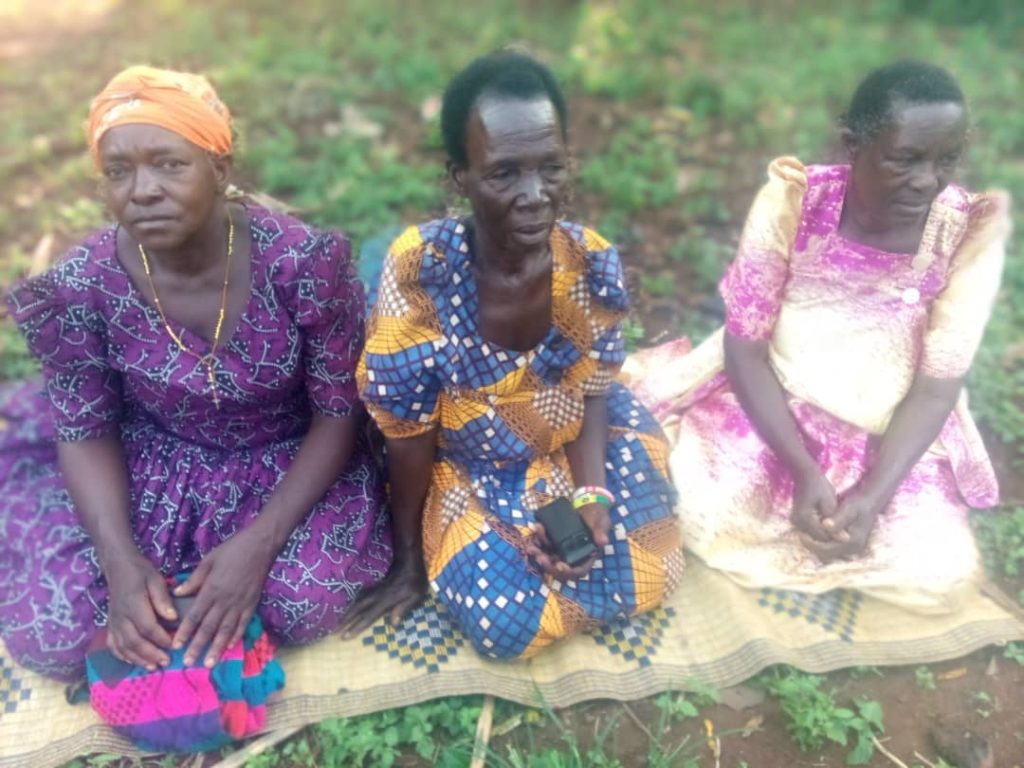
“When he died, I lost touch of events and processes surrounding our compensation. The late registered our son as the next of kin and I don’t get updates regarding our compensation package”, Mrs. Kigenyi narrated to this website.
Mrs. Kigenyi’s frustrations are exacerbated by the fact that they were stopped from utilizing the land.
“We aren’t supposed to use this land for anything but I use the land for cultivation of food crops and I’m not certain when they will forcefully stop me”, she narrated seemingly terrified.
Asuman Sssembatya, the Nabulembeko parish chairperson says as leaders, they have done all within their powers but PAPs’ compensations remain a toll order.
“These people come and promise our people timely compensation but when they leave us, things change”, says Mr. Ssembatya.
In May 2022, the EACOP reported that at least 41 percent of the Project affected persons-PAPs under the East African Crude Oil pipeline-EACOP project have been fully compensated in Uganda. There are 3,648 project affected persons-PAPs under the EACOP project in Uganda.
The 1,443km crude oil export pipeline will transport Uganda’s crude oil from Hoima in Uganda to the Chongoleani peninsula near Tanga port in Tanzania.
It is envisaged to be the longest electrically heated pipeline in the world and will cross through 10 districts in Uganda, a distance of 296 kilometers and 25 districts in Tanzania, covering eight regions and 25 districts.
The government rolled out the program of acquiring land for the project in August 2018.
According to the agreed plan, the pipeline route will begin from Hoima through Kikuube, Kakumiro, Kyankwanzi, Mubende, Gomba, Sembabule, Lwengo, Kyotera, and Rakai and cross the Tanzania border between Masaka and Bukoba, and traverse Tanzania through Kahama, Singida, Kondoa, into Tanga.
The governments of Uganda and Tanzania signed an Inter-Governmental Agreement (IGA)for the EACOP Project on 26 May 2017.
Community Green radio has been working closely with the PAPs to ensure their rights are fully respected during the implementation of all Oil and Gas related developments. The radio serves as a platform for the grassroots as their voice.
NAPE has made an analysis of the socio-economic and ecological values of Bugoma Forest in Buhanguzi County, Kikuube District .
Click for the full report.
Copyright ©2026 Community Green Radio . All Rights Reserved. Designed : Lwegatech