
Thursday, May 7th, 2026 | By
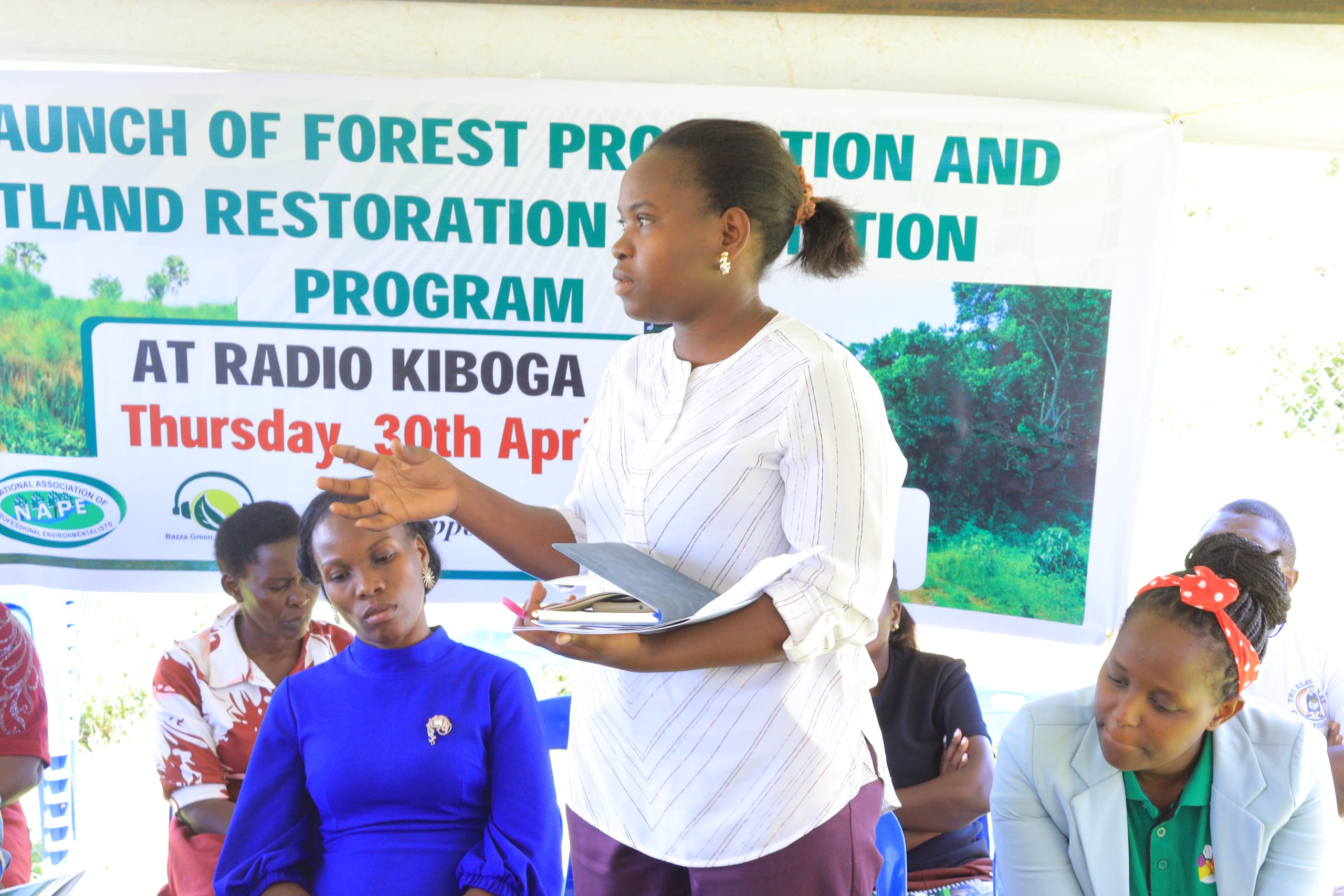
Communities in Kiboga and Kyankwanzi districts are being argued to plant more trees if they are to keep their environment safe and healthy.
Henry Lubanjwa, the Assistant Resident district commissioner, RDC (Presidents representative in the district) for Kiboga says trees protect the environment but also offer other benefits of providing shades, soil conservation and improved air quality.
“We need more trees to regulate our climate, protect our water sources and support agriculture. Without trees, we are exposing ourselves to drought, floods and soil erosion,” the President’s representative explained.
Mr. Lubanjwa made the remarks while officiating as chief guest at the launch of the Forests and Wetlands Restoration Promotion Program held at the office of the Community Green Radio in Kiboga District at the end of last month.
The launch was organized by the National Association of Professional environmentalists, NAPE with partners like African Institute for Biodiversity and Sustainability, AIBIS and attracted a host of local leaders from the two districts, technical staff and cultural leaders.
Prominent at the launch were Kiboga Town Council Chairperson Henry Kagali, Kiboga district agriculture Officer Bugembe Musa Ssegujja, Kiboga District Forestry Officer Ms. Margret Nanyonga and the district Police commander Jjingo Julius.
Buganda Kingdom representative at the function, the Sabawaali for Kapeke Parish, Mr. Johbosco Ssenyondo called on the communities to take an active role in environmental conservation by planting and taking care of trees in their homes, schools and public places.
“We have a responsibility to protect our environment for future generations. Let’s work together to restore our forests and wetlands”, Ssenyondo said.
Kiboga town council Chairperson Henry Kagali revealed how some business people are largely responsible for the continued degrading of the environment through clearing forests and reclaiming wetlands. He underscored the need to collectively deal with the perpetrators.
“We need to hold accountable those who cut down trees without permission and destroy our wetlands. We need to work together to protect our environment”, Kagali said.
David Kureba, The Senior Program Coordinator Forests, Biodiversity and Climate Change at NAPE explained that Forests and Wetlands Restoration Promotion Program is aimed at restoring degraded ecosystems, promote sustainable land use practices and enhance community resilience to climate change.
He added that the program will involve tree planting, wetland restoration, and environmental education.
“We will work with communities to establish tree nurseries, plant trees and maintain them. We will also support communities to develop sustainable land use plans and implement climate-smart agriculture practices,” Kureba said.
The launch climaxed with a tree-planting ceremony at Community Green Radio, symbolizing the start of a new chapter in environmental conservation.
Forest Restoration & Wetland Promotion Program Is a community-based environmental initiative focused on reversing land degradation while promoting the value and sustainable use of natural ecosystems. It’s also a coordinated set of activities that do bring back trees and ecological health to degraded, deforested, or bare land. Wetland Promotion – Protecting existing wetlands and restoring damaged ones, while educating people on why wetlands matter for water, climate, and livelihoods. Forests and wetlands work together as a water system. Forests on hillsides slow rainwater, reduce erosion, and recharge groundwater. Wetlands in valleys filter that water, store it, and release it slowly into the aquifers.
Uganda loses approximately 122,000 hectares of forest land annually, with forest cover decreasing from 24% in the 1990s to roughly 13% recently. This is largely caused by Unregulated Logging and Timber Demand, Urbanization and Infrastructure Expansion, Weak Governance & Land Tenure Issues, Biomass Energy Demand, High Population Growth & Poverty, Agricultural Expansion among others.
Wetlands are disappearing three times faster than forests, with approximately 35% of global wetlands lost between 1970 and 2015. Driven by agricultural expansion, urbanization, and climate change, this rapid degradation threatens biodiversity and reduces critical carbon sinks, with the highest rates of loss occurring in developing nations. Nearly a quarter of remaining wetlands are in poor ecological condition. In Uganda, wetland coverage declined from roughly 15.5% in 1994 to approximately 8.9%–9.3% in 2024–2025. The major trends and drivers include; Rapid Urban and Industrial growth, encroachment, Institutional and Legal Weaknesses. Wetlands and forests don’t work in isolation. Their environmental services work in complementarity.
STORY COMPILED BY SSENKOOMI GERALD AND KYAMANYWA JULIUS
Copyright ©2026 Community Green Radio . All Rights Reserved. Designed : Lwegatech